The practical answer.
Accept a storage energy claim against a written boundary and test sequence. Record usable DC energy, delivered AC energy and charging energy separately, with matching start and end conditions. A nameplate kWh value, an inverter efficiency figure and an AC round-trip result describe different quantities and cannot be substituted for one another.
- Keep battery capacity acceptance separate from installed AC energy acceptance.
- Count auxiliary consumption once, at its actual measurement boundary.
- Repeat the agreed operating profile before attributing a difference to battery degradation.
1. Write the claim as a measurable service
Before discussing a percentage efficiency, write what the installation must deliver: a defined energy amount at a particular electrical interface, at a stated power profile, before reaching an agreed stopping condition. Include whether this is commissioning acceptance or an in-service retention check. The second question compares a system with its previous condition; the first compares delivery with a purchase specification. Mixing them can turn a normal operating reserve into an apparent failure.
Sandia’s performance framework distinguishes energy rating, discharge duration and round-trip efficiency, and includes losses inside the selected boundary. Our proposed acceptance workflow applies that distinction to a smaller storage project. It is an editorial planning method, rather than a claim that a specific Jetray system has completed a named test protocol. The purchaser, battery supplier and installation integrator should agree the actual procedure.
2. Separate the three energy quantities
Nominal battery energy is usually a reference quantity derived from rated charge capacity and nominal voltage, under the model’s stated definitions. Usable DC energy is what crosses the battery-side measurement point during an agreed discharge window. Delivered AC energy is what crosses the selected inverter output or installation interface during the same operating sequence. An internal battery display may not measure all three.
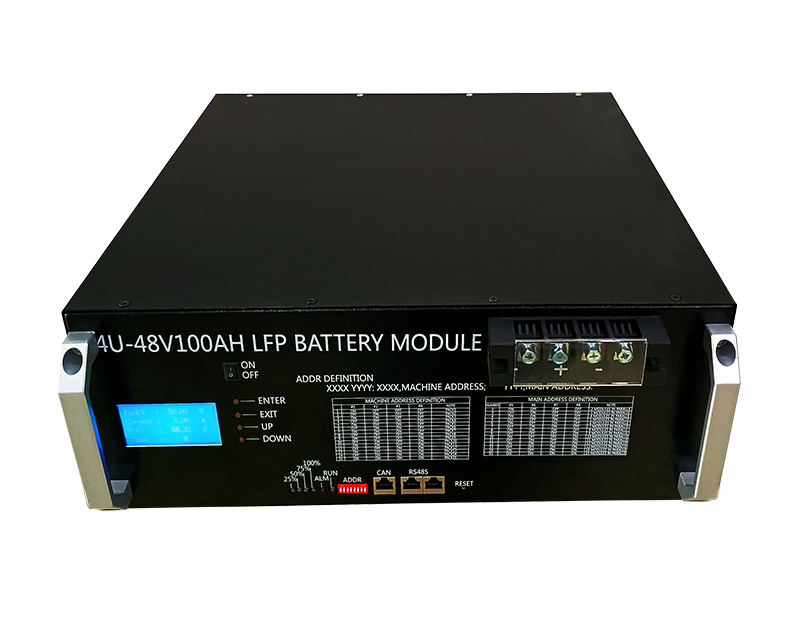
Jetray’s published 48V 100Ah rack-style reference lists 4,800Wh. That listing is useful product identification; it is not an installed AC energy guarantee. Do not silently replace the listed nominal voltage with another manufacturer’s nominal value to make a larger energy figure. Ask for the approved model sheet, capacity-test conditions and the definition used in the quotation before comparing the reference with a proposed installation.
3. Draw the boundary before positioning the meters
Use a simple single-line drawing to mark every energy meter, the battery terminals, conversion equipment, AC output and auxiliary supply paths. Decide whether the accepted service includes cooling, communications, contactor supply and any other control loads. A separately powered accessory may be outside the battery meter yet still consume energy paid for by the owner. State that explicitly rather than hiding it in an efficiency adjustment.
The same physical system can produce different legitimate efficiency numbers at different boundaries. A module-side DC result describes a different service from energy delivered after an inverter and its auxiliaries. Request a diagram with each reported number. For the practical plan, label meters A, B and C and keep those labels on the data files, report and acceptance table.
| Quantity | Measurement boundary | Decision it supports |
|---|---|---|
| Usable DC energy | Agreed battery-side interface | Battery window and discharge acceptance |
| Delivered AC energy | Agreed load or system interface | Energy actually supplied to the installation |
| AC round-trip efficiency | AC output divided by AC charging input, equivalent endpoints | Full-cycle conversion and system losses |
| Idle consumption | Defined mode and observation duration | Energy retained while waiting |
4. Define starting and stopping conditions
A test is difficult to repeat if its instruction is simply to start at 100% and finish when empty. Specify how the initial charged condition is established, what stabilization is required, how the normal reserve is applied and which approved limit ends the discharge. Keep the protective BMS disconnect distinct from the normal control stop. Acceptance should use permitted operation, rather than intentionally defeating protective limits.
Record firmware, battery configuration, ambient conditions and the actual limits active during the run. A percentage displayed by a controller is one observation; it is not independent evidence that two batteries began at identical stored energy. Ask the supplier to identify the applicable completion criteria for the model. Include an invalid-test rule for alarms, interrupted charging or an uncontrolled load change.
5. Use a worked dataset without treating it as a product promise
Consider a hypothetical acceptance dataset, not a Jetray measurement. A battery supplies 3.70kWh across the agreed DC boundary while the corresponding AC output meter records 3.33kWh. The discharge-path energy ratio is 3.33 divided by 3.70, or 90.0%. If restoring the system to its agreed initial condition requires 4.10kWh at the AC charging interface, the full AC round-trip ratio is 3.33 divided by 4.10, approximately 81.2%.
Those percentages answer different questions. Multiplying a nominal capacity by a round-trip percentage does not isolate the usable energy available on one discharge. Equally, applying both an already measured AC delivery loss and a second assumed inverter loss would count conversion losses twice. Label the hypothetical numbers, equations and boundaries when presenting an estimate to a buyer; replace them with actual agreed measurements before acceptance.
6. Control the load profile and elapsed time
A system supplying a large load for a short period does not necessarily deliver the same AC energy as the same battery serving a small load over a long interval. Fixed consumption has more time to accumulate during a slow discharge. The inverter also operates at different points on its efficiency curve. Record a representative power schedule instead of relying only on a single average power value.
For a repeatable acceptance run, define transitions, dwell times and the permitted variation around each step. For an operational trial, retain the actual time series and mark deviations from the planned schedule. Keep peak-power capability as a separate pass criterion: an acceptable total energy result does not prove successful motor starts or load transitions. A test report should answer both energy and operational questions without confusing their units.
7. Treat idle periods as part of the operating story
Some systems wait for many hours between charging and useful discharge. Decide whether that wait belongs inside the accepted duty cycle or is measured separately. A battery-side energy figure collected immediately after charging cannot by itself characterize an installation that must preserve a reserve through a long idle interval. State the duration and the mode used during that wait.
Manufacturer operating modes can change the tradeoff. For example, the cited Victron manual describes an ECO search mode that periodically checks for a sufficient load; that is not identical to a continuously energized output. Do not transfer its numerical settings or claimed reduction to a different inverter. If an energy-saving mode is proposed, verify that the actual supported loads wake and operate as required.
8. Agree measurement uncertainty and repeat rules
Ask for meter identification, calibration status, range and the sampling approach used to calculate energy. A display rounded to one decimal place may be adequate for routine operation while being insufficient to settle a narrow contractual acceptance difference. Include uncertainty in the reporting method, especially when auxiliary loads are small relative to the selected current sensor range.
Do not choose a new pass limit after seeing a result. Write the allowed conditions, minimum valid observation period, handling of missing samples and repeat policy before the test. If two runs differ, investigate temperature, starting condition, power schedule and operating events before averaging them. Repeating only the more favorable run creates a persuasive number without establishing a repeatable service.
9. Build an acceptance record that service teams can reuse
Keep a machine-readable data export alongside the signed summary. The summary should identify the exact battery units, inverter, control software and document revisions. It should also list departures from the plan and unresolved observations. This makes the commissioning result a useful baseline for later troubleshooting rather than an isolated marketing certificate.
When requesting a storage proposal from Jetray, supply the intended installation interface, operating schedule and proposed acceptance boundary. Ask which values are model-specific commitments and which remain estimates pending integration. Use the linked product references to organize that discussion; similar voltage or dimensions do not establish compatibility. The goal is an evidence package that both purchasing and engineering can interpret in the same way.
- Agree the service, boundary, permitted operating window and test responsibility.
- Record equipment identity, approved settings and meter details.
- Establish the specified initial condition and run the approved profile.
- Export energy, time, temperatures, limits and event logs.
- Compare results with the pre-agreed criteria and document any repeat.
Questions buyers should resolve before approving the report
Is usable battery capacity the same as AC energy delivery?
No. Battery-side capacity and energy concern a defined battery test, while AC delivery includes the chosen conversion path and system operating conditions. Ask where the accepted quantity is measured and which losses are included.
Can I compare two round-trip efficiency percentages directly?
Only when their boundaries, operating profiles and endpoint definitions are comparable. A cell-level or DC-only value is not equivalent to an AC system result. Missing conditions should remain unresolved rather than being filled with an assumed correction.
Does a lower result always mean the battery has aged?
No. Changed operating reserve, temperature, load duration, auxiliaries or measurement conditions can affect the result. Compare like-for-like records before treating a difference as capacity loss or making a warranty determination.
Sources & further reading
- Sandia LDES National Consortium: performance definitions and system boundary ↗
- Sandia SAND2012-9422: Evaluating Utility Procured Electric Energy Storage Resources ↗
- Jetray published 48V 100Ah LiFePO4 reference ↗
- Victron SUN Inverter manual: operating modes and load-dependent settings ↗
AI-assisted engineering and procurement education, checked against the cited original sources. Calculations and example data are illustrative, not Jetray test results. Use the approved battery and inverter instructions and qualified system personnel for installation or settings changes.
Prepared for the energy storage batteries collection. General engineering guidance does not replace a model-specific datasheet or application validation. Source review: 5 November 2026.